Sauna heater size calculator
Set your room dimensions — by typing, or by dragging the corner of the drawing — and add any glass or stone. The recommendation updates live.
Inside face to inside face. Type 7' 6" or 7ft 6in if you like.
Inside width, not the outer frame.
Floor to ceiling. Lower ceilings need smaller heaters.
Door and windows. A standard glass sauna door is about 16 sq ft.
Any uninsulated hard surface. Leave at zero for an all-wood room.
The common convention is 1 kW per cubic metre. Your heater brand may differ.
What this assumes
- 1 kW per cubic metre of effective volume is the general industry convention, adjustable above.
- Glass adds 1.2 m³ of effective volume per m², stone and concrete 1.5 m³ per m². These surfaces soak up and lose far more heat than an insulated panelled wall, so the room behaves as if it were bigger than it measures.
- The result is a range bracketed to ratings that are actually sold. Sizing is a convention, not a physical constant, and a single decimal figure would imply precision nobody has.
- Manufacturers differ. Check the chart for the brand you are buying — and its minimum room volume, which matters as much as the maximum.
—
Fill in the fields to see your answer.
- Room volume—
- Glass adds—
- Stone adds—
- Effective volume—
How this calculation works
- Room volume
- Add for glass and stone
- Effective volume
- Heater kW range
kW = (L × W × H + glass m² × 1.2 + masonry m² × 1.5) × 1.0
Measure the room inside, multiply for volume, then add extra volume for any surface that loses heat faster than an insulated timber wall. Multiply the total by the sizing rule — conventionally 1 kW per cubic metre — and round out to heater sizes you can actually buy.
| Effective volume | Room roughly | Typical heater |
|---|---|---|
| 3–4.5 m³ (105–160 ft³) | 2-person corner | 4.5 kW |
| 4.5–6 m³ (160–210 ft³) | Small 2–3 person | 6 kW |
| 6–8 m³ (210–280 ft³) | Typical 4-person | 8 kW |
| 8–9 m³ (280–320 ft³) | 4–5 person | 9 kW |
| 9–10.5 m³ (320–370 ft³) | Large family | 10.5 kW |
| 10.5–12 m³ (370–425 ft³) | Large, or lots of glass | 12 kW |
Where the adjustments come from
| Surface | Adds per m² | Per ft² |
|---|---|---|
| Glass (door, window) | 1.2 m³ | 0.11 m³ |
| Stone, tile, concrete | 1.5 m³ | 0.14 m³ |
| Insulated timber | nothing | nothing |
Why glass changes the answer so much
A sauna's heater is sized against how fast the room loses heat, not just how much air it holds. An insulated, foil-backed, cedar-panelled wall holds heat well. A glass door does not — it conducts heat straight out and has no insulation value worth counting. The convention of adding equivalent volume for glazing is a way of saying "this room behaves like a bigger one".
The practical version: a full glass front on a small sauna can push you up a whole heater size. It is worth deciding on the glazing before you buy the heater, not after.
Ceiling height is the cheapest fix
Volume scales directly with ceiling height, and heat stacks at the top of the room where nobody is sitting. Dropping a 2.4 m ceiling to 2.1 m cuts roughly an eighth off the required heater — often a whole size — and makes the room heat faster too. If you are building from scratch, this is the single easiest saving available.
Before you buy
- Check the heater's minimum room volume as well as its maximum — an oversized heater in a small room cycles badly and scorches.
- Heaters above about 6 kW generally need a dedicated 240 V circuit; above 18 kW you are usually into three-phase supply.
- Have an electrician confirm your panel can carry the load before ordering.
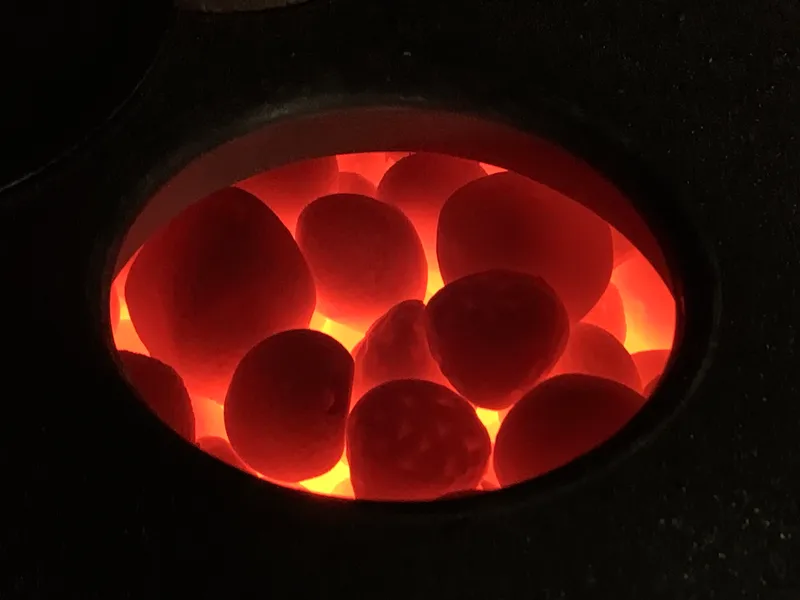
For the reasoning behind these numbers, read how sauna heater sizing actually works. Once you have picked a heater, the sauna running cost calculator shows what it will cost to use.
Related calculators
- Sauna Electricity Cost Calculator
What one sauna session costs, and what that adds up to per month and per year.
- Hot Tub Electricity Cost Calculator
Split your running cost into keeping it hot, the circulation pump, and reheating.
- Hot Tub Heat-Up Time Calculator
How long from cold to ready, and what that one heat-up costs.