What wiring does a sauna heater need?
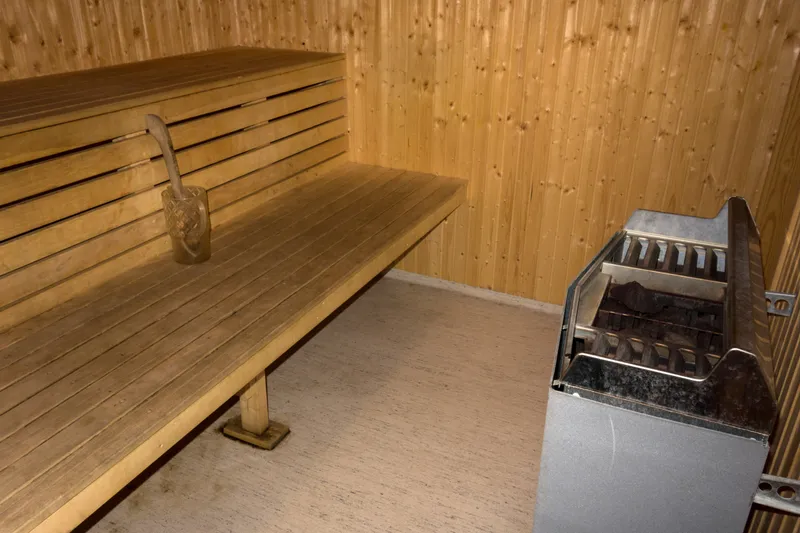
A home sauna heater needs its own 240-volt circuit. A 6 kW heater draws 25 amps, and the Harvia and Finnleo manuals both call for 10-gauge copper wire. An 8 kW heater draws 33.3 amps and needs 8-gauge. Your electrician picks the breaker. Expect it to be rated higher than the heater’s amps, not equal to them.
Here is where those numbers come from, and what to settle before you buy.
How many amps does a sauna heater draw?
Divide the watts by the volts. A 6 kW heater is 6,000 watts. At 240 volts, that is 6,000 ÷ 240 = 25 amps.
The heater pulls that full amount the whole time it warms the room. Later it cycles on and off, which is why a session costs less than you’d guess. The wiring doesn’t get that break. It has to carry the peak.
What size wire does each heater need?
These are the 240-volt, single-phase figures from the Harvia KIP manual and the Finnleo Designer manual. The two makers agree on every size they both list.
| Heater | Amps at 240 V | Copper wire | Amps × 1.25 |
|---|---|---|---|
| 3 kW | 12.5 A | 12 AWG (Harvia only) | 16 A |
| 4.5 kW | 18.8 A | 10 AWG | 23 A |
| 6 kW | 25 A | 10 AWG | 31 A |
| 8 kW | 33.3 A | 8 AWG | 42 A |
A smaller gauge number means a thicker wire. So going from 6 kW to 8 kW means thicker wire as well as a bigger breaker.
Both manuals list separate, lower amp figures for 208-volt service. If your building has 208 volts rather than 240, use those rows from your own heater’s manual, not this table.
What size breaker does a sauna heater need?
Neither manual gives a breaker size, so I haven’t put one in the table.
The last column is there for a reason. The electrical code treats fixed electric heat as a continuous load. For that kind of load, the wire and the breaker must be rated for at least 125% of what the heater draws, as Mike Holt explains for NEC Article 424. If your electrician applies that rule to the sauna, a 6 kW heater’s 25 amps becomes 31 amps. The breaker has to be at least that.
How your local inspector reads the code is the electrician’s job to know. Bring the heater’s manual to the quote.
Does the room size change the wiring?
Yes, through the heater. The sauna heater size calculator adds extra volume for glass. A room 1.8 by 1.5 meters with a 2.1 meter ceiling needs 4.5 to 6 kW. Add 1.6 square meters of glass, about a full glass door and a small window, and it needs 6 to 8 kW. If you land on 8 kW, that’s 8-gauge wire.
So decide on the glass first, then size the heater, then pull the wire. Doing it the other way round can mean pulling wire twice.
Does a sauna heater need a GFCI?
Not the Harvia. A GFCI (ground fault circuit interrupter) is the kind of breaker that cuts power when it senses current leaking to ground. Harvia’s manual calls for a standard 2-pole breaker and says “no GFI may be used.” It warns of nuisance tripping, and says a GFI breaker voids the warranty on internal parts.
That runs against the instinct to add a GFCI to anything near water. Follow your heater’s manual and your local code, and ask your electrician if the two disagree.
What wire goes inside the sauna walls?
Both manuals call for copper wire rated for 90 °C (194 °F). Harvia says this for all wiring inside the sauna walls and ceiling. It also runs the last stretch to the heater in flexible conduit, and says not to put an outlet inside the sauna room.
What about an infrared sauna?
Many home infrared cabins run on 120 volts. Of the five models on the sources page, four do, and their makers call for a 15 or 20 amp circuit. The three-person Clearlight runs on 240 volts. Check the label and the manual on your model for the circuit it needs.
Before you order the heater
- Check your panel. A 240-volt heater needs space for a two-pole breaker, and spare capacity for the heater’s full amps.
- Read your heater’s own manual before the electrician quotes. If its table and mine differ, the manual wins.
- Ask your city about a permit for the new circuit before the work starts.
The running cost is the easy part once it’s wired. The sauna cost calculator prices a session for your heater size and rate.