How much does a hot tub cost in winter?
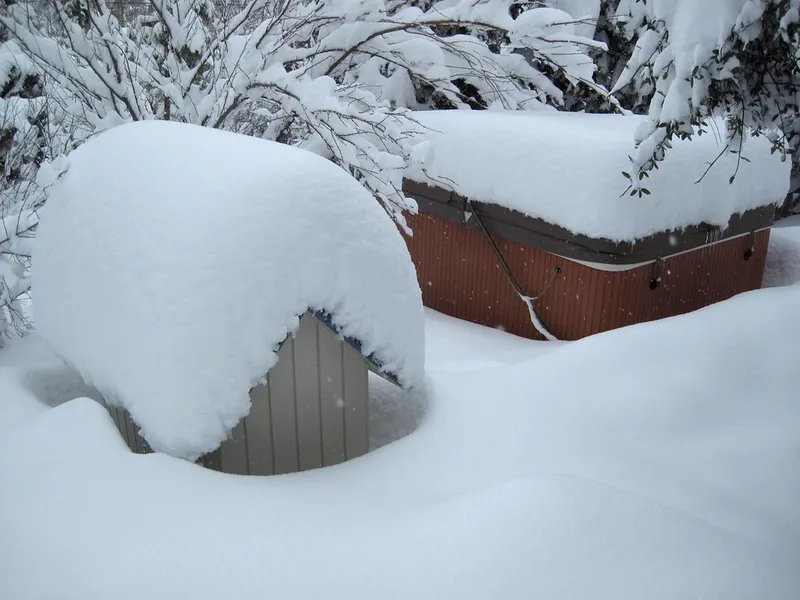
A 400 gallon hot tub with a good cover, kept at 100 °F, uses about 270 kWh a month when it averages 50 °F outside. When the average drops to 30 °F, it uses about 360 kWh. At 17 cents a kWh, that is roughly $45 a month rising to $60. With a tired cover, the same cold month costs about $135.
The cover matters more than the weather. Here is the full picture.
How much electricity does a hot tub use each month?
These come from the hot tub cost calculator. The tub holds 400 gallons at 100 °F. The pump draws 200 W for 8 hours a day. Power costs $0.17 a kWh.
| Average outside | Good cover | Standard cover | Thin or old cover |
|---|---|---|---|
| 70 °F | 180 kWh, ~$30 | 260 kWh, ~$45 | 370 kWh, ~$60 |
| 50 °F | 270 kWh, ~$45 | 390 kWh, ~$65 | 580 kWh, ~$100 |
| 30 °F | 360 kWh, ~$60 | 530 kWh, ~$90 | 790 kWh, ~$135 |
| 10 °F | 450 kWh, ~$75 | 670 kWh, ~$115 | 1,000 kWh, ~$170 |
Use the monthly average for your area, not today’s low. A cold snap for a week doesn’t set the bill. The average for the month does. If your rate isn’t 17 cents, put your own into the calculator. The kWh figures stay the same. Only the dollars change.
Why does cold weather cost so much more?
The tub loses heat in proportion to the gap between the water and the air. At 50 °F outside, the gap is 50 degrees. At 30 °F, it is 70 degrees. That is 40% more gap, so about 40% more heat leaks out, and the heater has to put it back.
The pump doesn’t care about the weather. It uses about 49 kWh a month in every row. All the growth is in keeping the water hot.
What actually saves money in winter?
The cover, by a long way. At 30 °F outside, going from a thin cover to a good one drops the bill from about $135 to $60. Seat it fully every time, and brush snow off so the weight doesn’t crush the foam. The hot tub cover guide covers how to tell if yours has failed.
Pump hours, if yours runs all day. A 200 W pump running 24 hours uses about 146 kWh a month. Cut to 8 hours and it uses about 49. That saves around $16 a month. Check your manual for how long it needs to filter first.
The setpoint, a little. At 30 °F outside, going from 102 °F to 100 °F saves about 9 kWh a month. That is about $1.50. It’s real, but it’s small, because two degrees is a small slice of a 70 degree gap.
Should you turn a hot tub off for the winter?
No, not if you plan to use it. Both owner’s manuals cited here say to keep it full and running. Hudson Bay Spas says the maker “does not recommend draining your spa and disconnecting the power supply in the winter.” Its freeze protection turns the tub on when the water falls to 44 °F, but only if the power is on.
If you do shut it down, draining it isn’t enough. The same manual says all the water has to come out of the pumps, heater, jets and pipes, and suggests hiring a pro. Coast Spas says to drain it if you will leave it alone for a long time in the cold, because a power cut could freeze it.
Should you turn it down while you’re away?
Turning it down helps less than you’d think. Take a week away at 30 °F with a good cover. Drop the setpoint to 80 °F and the tub cools for about two days, then holds there. It saves about 18 kWh over the week, which is about $3.
When you get back, the heat-up time calculator says a 4 kW heater takes five to six hours to climb from 80 °F back to 100 °F. Start it the morning you come home if you want to soak that night.
Leave it on and set lower, not off. A tub that is on still runs its freeze protection.
If you’re still choosing a tub, the heater size matters more in winter than in summer. See whether a 120-volt plug-in tub is enough in winter.
What if the power goes out in a freeze?
Hudson Bay’s manual suggests a low-wattage space heater inside the cabinet near the pumps, as a stopgap. It also says never to leave that heater running while you’re away. If the tub won’t run once power is back, the manual says to switch the GFCI off for 30 minutes, then on again. If that fails, call your dealer.